
Our goal is to provide a reliable, data-driven list of the top tiny home builders in South Africa. Over the coming months, we’ll be gathering data in order to compile that list, but the following is based on a more superficial review of the information readily available online.
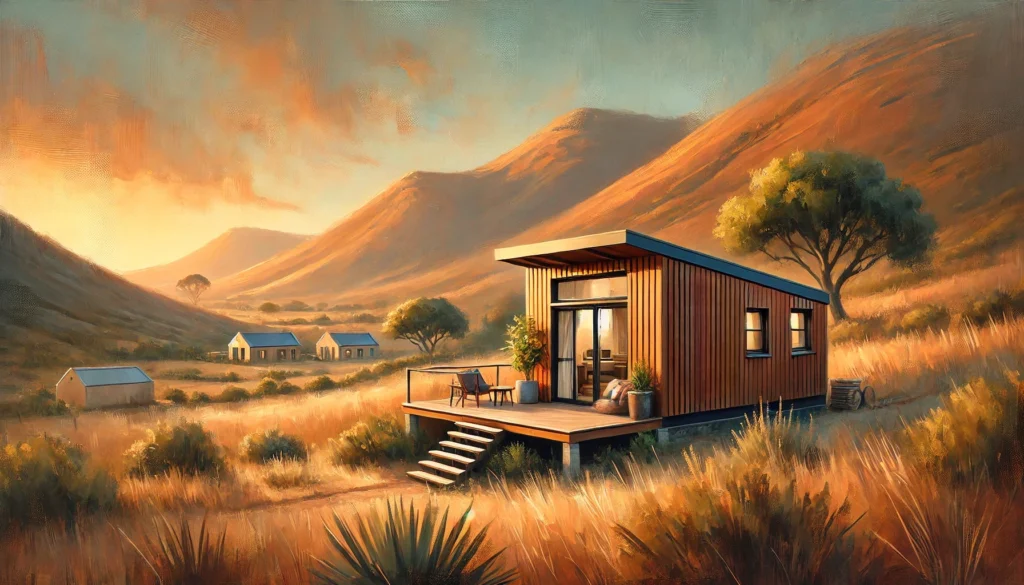
If you’re wondering where to buy a tiny house in South Africa, the companies below are a good place to start!
Here’s our list of the top Tiny Home Builders in South Africa
Last updated: December 2025
Our goal is to provide a reliable, data-driven list of the top tiny home builders in South Africa. Over time, we’re combining online research with direct outreach, site visits, and community feedback to refine this list.
Because SEO is still developing in South Africa, we’re not just looking at who ranks well on Google. We’re prioritising:
- Evidence of real builds in South Africa (not just renders)
- Responsiveness to enquiries
- A track record of quality and professionalism
- Clear alignment with the tiny home / modular / small-footprint ethos
If you’re wondering where to buy a tiny house or small modular home in South Africa, the companies below are a good place to start.
Tinyhome South Africa
Website: https://tinyhome.africa/
Overview:
Tinyhome South Africa builds contemporary, off-grid, modular and movable tiny homes, including pod-style cabins and larger Figur 8/9/10/11 models that can be configured as tiny houses on wheels or as semi-permanent installations. Their range is aimed at people who want to downscale, add a rental unit, or create off-grid guest accommodation.
Pricing: O Pod office units start from about R249,000, with compact Studio cabins from roughly R288,000–R538,000. Full Figur tiny homes (8–11m long, 24–33 m²) run from around R697,000 for a Figur 8 up to about R943,000 for a Figur 11 (prices include VAT and exclude delivery and custom extras).
Why they stand out:
- Real tiny home focus: Product range and branding are explicitly centred on tiny homes and pods, not just generic small houses.
- Movable + modular: Units are prefabricated in a factory and can be transported and combined, supporting both THOW-style living and more permanent setups.
- Off-grid friendly: Design and marketing emphasise off-grid living, making them attractive for remote plots and eco-tourism projects.
Bungalo – Modular Pods & Eco Cabins
Website: https://www.bungalo.co.za/
Overview:
Bungalo builds minimalist modular pods designed for off-grid, low-carbon living. Their units are popular for use as guest accommodation and small homes, and they actively market to the eco-tourism space. Bungalo pods are modular rather than road-legal Tiny Homes on Wheels (THOWs), but they fit very comfortably within the tiny-home lifestyle.
Pricing: A fully kitted 54 m² Bungalo unit is currently listed at about R940,000 (VAT inclusive), while the larger 81 m² option is around R1,490,000 (VAT inclusive). These prices exclude foundations, delivery, and optional upgrades.
Why they stand out:
- Proven installations: Bungalo has multiple pods installed at real-world sites, including properties with several units on one plot and a show Bungalo at Buitenverwachting Wine Farm.
- Design & finish: Their pods have a clean, modern aesthetic that looks good in person, not just in renderings.
- Off-grid orientation: Strong emphasis on eco-friendly, off-grid modular homes, with local council submissions and site preparation built into their offering.
TinyMods – Steel Frame Tiny Homes & Pods
Website: https://tinymods.co.za/
Overview:
TinyMods specialises in steel-frame tiny homes and pods, offering a mix of standard layouts and bespoke projects. Their work includes small homes, studios, and other compact structures, with a combination of renders and photos of real installations and in-progress builds.
Pricing: TinyMods’ catalogue shows smaller structures like storage pods from about R115,000, “mini sleeper” cabins from roughly R200,000–R250,000, and glamping-style units (Glamper, Curve, Loft) clustering around R400,000–R460,000. Larger L-shape and two-bedroom U-shape configurations run up to roughly R793,500–R1,012,000 (VAT inclusive, delivery quoted separately).
Why they stand out:
- Legit build portfolio: Their gallery and social channels show actual projects and build stages, not just concept imagery.
- Bespoke approach: They emphasise working closely with clients to tailor layouts and finishes.
- Steel frame construction: Light steel framing offers durability and design flexibility, which suits both coastal and inland climates.
iKhaya Modular Homes
Website: https://ikhayamodular.co.za/
Overview:
Ikhaya Modular Homes designs and builds prefabricated mass-timber modules that can function as compact homes, studios, or guest units. Clients can choose from six pre-designed modules (including the Cabin, Coast, Mountain, Shack, Studio, and Valley) or commission a tailored design. These buildings are pre-manufactured, sustainable, and certified modular solutions, with fittings and furniture available as part of a turn-key package.
Pricing: Ikhaya Modular’s mass-timber modules currently range from about R255,000 ex VAT for a compact Shack module with deck, to around R537,000 ex VAT for a Studio module, and up to roughly R868,000 ex VAT for a larger, two-level Cabin module (foundations, installation and finishes can shift the final figure).
Why they stand out:
- Mass-timber tiny home option: Their Cabin module is effectively a small home, with 41m² of space including a mezzanine level and generous covered deck, described as “that perfect little home.”
- Proven build history: Ikhaya notes experience delivering at least 19 fully fitted modular structures, giving some reassurance that the system has been tested on real projects rather than just in concept.
- Sustainability focus: They emphasise locally sourced timber, carbon-negative structures that “touch ground lightly,” and a streamlined process from design to installation, typically in an 8–10 week timeframe.
The Tiny Big House – PoDHoMES
Website: https://tinybighouse.co.za/
Overview:
The Tiny Big House builds modular PoDHoMES – compact, eco-friendly pods designed for tiny living and investment properties. They offer a fairly standardised range of options at accessible price points and take a turn-key approach, handling design, engineering, council permissions and installation.
Pricing: Marketing material for PoDHoMEs shows smaller mobile units from roughly R184,000–R199,000 (excl. VAT and delivery), with larger studio and family layouts ranging up to about R550,000–R640,000, depending on size and spec.
Why they stand out:
- Turn-key process: They explicitly manage the full process from design to installation, including council submissions, which is a major value add in South Africa.
- Active project pipeline: Recent social posts show completed projects and installations, indicating that they’re actively building and delivering units.
- Investment-friendly: Their marketing clearly targets people who want to add income-generating units (e.g. guest pods, rental suites) to existing properties.
Wendycorp – Nutec Tiny Homes South Africa
Website: https://wendycorp.co.za/
Overview:
Wendycorp is a long-standing Nutec and timber structure company that offers Nutec tiny homes, studios, and multi-bedroom small houses. While they’re not exclusively focused on “tiny houses” as a lifestyle, their smaller units can serve as tiny homes, guest suites or home offices.
Pricing: Wendycorp’s “Tiny Homes Villa” is listed at around R178,000 (Nutec-clad unit with verandah and basic finishes, delivery excluded). Other tiny-style Nutec homes are priced by custom quotation rather than a fixed public price list.
Why they stand out:
- Established operator: They’ve been active in Nutec housing for years, with a broad footprint and multiple project types.
- Nutec construction: Nutec cladding provides a durable, low-maintenance exterior suitable for varied South African climates.
- Range of sizes: You can configure anything from compact studio-style spaces to small family units, depending on your needs.
GPM Services – Light Steel Frame “Tiny Homes”
Website: https://gpmscon.com/
Overview:
GPM Services focuses on Light Steel Frame (LSF) technology and offers prefabricated residential units that can work as tiny homes. Their background is more engineering-driven than lifestyle-driven, but that’s a plus if you value structure and compliance above all else.
Why they stand out:
- Engineering first: LSF construction offers strength, thermal efficiency and speed of installation.
- Prefab efficiency: Units are prefabricated and designed for quick assembly, which can reduce on-site disruption.
- Versatile use cases: Their small residential units can function as tiny homes, staff accommodation, or additional dwellings.
Swissline Design – Modular Timber Frame Homes
Website: https://modulartimberhomes.com/
Overview:
Swissline Design (Modular Timber Homes) is led by a Swiss master carpenter and specialises in modular timber frame buildings. While they aren’t exclusively a “tiny house” company, they do build smaller units that align with the tiny-home lifestyle and place a strong emphasis on craftsmanship.
Why they stand out:
- High-end timber work: Timber frame construction with a strong design and craftsmanship focus.
- Custom designs: They can adapt layouts to suit smaller footprints or more conventional homes.
- Sustainability: Timber and modular construction can reduce environmental impact compared to traditional brick-and-mortar builds.
Cozy Homes FS – Compact “Karoohuisies”
Website: https://www.cozyhomesfs.com/ (Cozy Homes FS)
Overview:
Cozy Homes FS builds small, NHBRC-registered homes with a “Karoo cottage” feel. Their units typically range from one to three bedrooms and are built to national South African building standards. They sit somewhere between classic tiny houses and compact conventional homes.
Why they stand out:
- NHBRC-registered: Compliance with national building standards is central to their offering.
- Proven builds: Photos and social media posts show multiple completed units across different sites.
- Cozy aesthetic: Their “Karoohuisie” style will appeal if you want a small, traditional-looking home rather than a ultra-modern pod.
Container Homes Cape Town – Container-Based Tiny Homes
Website: https://www.containerhomescapetown.com/tiny-homes-south-africa
Overview:
Container Homes Cape Town specialises in container and prefab buildings, including units marketed specifically as tiny homes. If you’re open to the industrial look and feel of containers, this can be a very practical and cost-effective route into tiny living.
Why they stand out:
- Sustainable reuse: Repurposed shipping containers offer a second life for existing materials.
- Robust shells: Container structures are robust and can be adapted for a wide range of climates.
- Flexible layouts: Containers can be used singly as micro-units or combined for larger spaces.
Builders Currently Under Review
There are a few other names in the South African market that clearly target tiny homes or tiny-adjacent spaces but are not yet on this “best of” list. Reasons include limited recent activity, uncertainty about whether they’re currently taking on new builds, or a lack of publicly visible real-world installations.
These include (among others):
- Freedom Tiny Homes – historic presence and real builds, but their website feels a bit neglected, and sparse recent updates.
- Wanderlust Co – strong THOW branding, but inconsistent online presence and a temporarily unavailable website at the time of writing.
- Tiny Homes SA – striking, highly futuristic designs and a clear tiny-home pitch, but a heavy reliance on rendered imagery and limited evidence (so far) of completed local builds. (Tiny Homes South Africa)
As we gather more data – including responses to enquiries, site visits, and verifiable case studies – we’ll continue to update this page. If you’ve worked with any of these builders (or one we’ve missed), feel free to reach out via our contact page to share your experience.
