
So you’ve fallen in love with the idea of a tiny home on wheels – parked on a beautiful piece of land somewhere between the mountains and the sea… but still legal to tow down the N2 or over Ou Kaapse Weg when you need to move it.
In South Africa, there’s no special “tiny house law”. On the road, your tiny home is basically treated as a caravan or large trailer. That’s good news, because it means we can work with rules that already exist – we just have to design and drive smart.
This guide focuses on roadworthy basics only: how to make sure your tiny house on wheels is legal to tow on public roads in Cape Town and the Western Cape.

1. On the road, your tiny home is a caravan
Under South African traffic law, a caravan is essentially an enclosed trailer designed for people to live in, pulled by a vehicle. That’s exactly what a tiny house on a flatbed is.
So when it’s on the road, your tiny home has to follow the same rules as:
- Caravans
- Boat trailers
- Other braked trailers over 750 kg
Those rules cover things like size limits, weight and brakes, lights and reflectors, and driver’s licence codes.
2. Size limits: don’t build yourself into a corner
South African law puts maximum limits on how big a trailer can be:
- Maximum width: 2.6 m
- Maximum height: 4.3 m (measured from the ground to the highest point)
For a Western Cape tiny home on wheels, the big ones to watch are width and height, and a nice safe design target is:
- Width: aim for 2.5–2.55 m
- Height: aim for 4.0 m or less
That gives you a buffer for suspension sag, bigger tyres, gravel roads, and the odd badly-crowned farm driveway, while still staying under the legal absolute maximum.
In terms of length, most tiny homes that are practical to tow with a bakkie or SUV sit in the same range as big caravans and boat trailers – roughly up to about 8 metres of body length and under 3 500 kg GVM. You can build longer, but once you go much beyond that you’re drifting into truck-and-trailer territory with more complex vehicle and licence requirements.
3. Weight and brakes: your tiny home will count as “heavy”
Almost all real tiny homes on wheels are well over 750 kg, which puts you into the “heavy trailer” category and triggers stricter brake rules.
According to South Africa’s National Road Traffic Regulations, 2000 (Regulation 151: Brakes on trailers), the rules are:
- Up to 750 kg GVM (fully loaded):
- Trailer must at least have a parking brake or device to keep it from rolling.
- Over 750 kg GVM:
- Trailer must have a proper braking system (typically overrun / inertia brakes) plus a parking brake.
- As weights climb, there are extra requirements about how the trailer’s GVM compares to the towing vehicle’s tare.
For a 6–8 m tiny home on a 2–3 axle flatbed, you should assume:
- You’ll need a braked trailer with decent capacity (often up to 3 500 kg GVM in the “O2” light-trailer category).
- You’ll need a tow vehicle (large bakkie / SUV) rated to safely pull that weight.
This is why it’s usually easiest to start with a purpose-built, South African-registered flatbed or caravan chassis and then build the tiny home on top of that, instead of trying to register a completely DIY chassis yourself. Source: Government of South Africa
4. Lights, reflectors and number plates: the “don’t get pulled over” basics
A roadworthy caravan or trailer in South Africa must have the usual set of lights and reflectors:
- Working tail lights and brake lights
- Working indicators
- Number plate light
- Red reflectors at the rear
- White reflectors at the front
- Amber reflectors or reflective tape along the sides
- In practice, most testing stations also expect yellow reflective tape for about 80% of the trailer’s length, and a compliant chevron board if you fit one.
If you buy a trailer chassis that’s already road-legal, it will come with these in the right spots. When you build the house on top, just make sure you don’t cover, move or block any lights or reflectors without re-installing them correctly.
5. Registration, licence disc and roadworthy
To tow your tiny home on public roads, the chassis itself must be a registered vehicle:
- It needs a VIN / chassis number and manufacturer plate.
- It must be registered on NaTIS as a trailer or caravan.
- It must have a valid licence disc and number plate.
When you buy or build, you’ll also deal with roadworthy tests at an accredited testing station. In the Western Cape, the province specifically notes that a roadworthy test is required when a vehicle changes ownership, and that no licence disc will be issued without it.
In normal-people English: before you tow your new tiny house home through Cape Town traffic, make sure:
- The trailer has already passed roadworthy, or
- You’re budgeting time and money to take it to a testing station and fix whatever they flag.
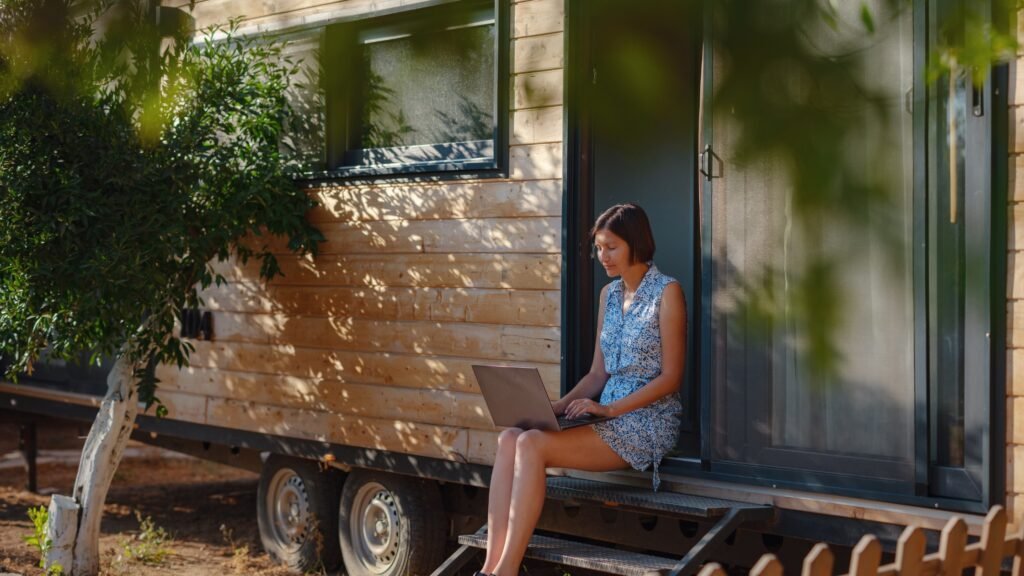
6. Towing it legally: Do you need a different license?
Basically, yes.
“In order to tow a heavier trailer, caravan or boat, a code EB license is required.”
– ArriveAlive.co.za
If your tiny home is heavier than 750 kg, you’ll need a Code EB licence, which basically means doing a learner’s test and one more driving test with a trailer at a local testing centre – a bit of admin, but very doable with a few practice lessons.
7. Putting it all together for a Western Cape tiny home
If we zoom out, here’s what “roadworthy” looks like for a typical 6–8 metre tiny house on wheels in the Western Cape:
- Built on a registered, braked trailer chassis rated for the full weight of the house and its contents.
- Overall width at or below 2.6 m, height at or below 4.3 m (aim for ≤ 4.0 m).
- Correct lights, reflectors, reflective tape, number plate and licence disc in place and working.
- A valid roadworthy certificate when required (especially at registration or ownership changes).
- A tow vehicle that’s rated to tow that GVM, with its own licence and insurance in order.
- A driver with a Code EB (or higher) licence who has actually practised towing something similar.
Do those things and you dramatically reduce the chances of an unpleasant surprise the first time you tow your tiny home through a roadblock outside Hermanus or over Sir Lowry’s Pass.
9. Final note (and friendly disclaimer)
This post is meant as a plain-language starting point for future tiny-home owners in Cape Town and the Western Cape. It’s not formal legal advice, and traffic regulations do change from time to time.
Before you commit to a specific design or buy a trailer, it’s worth:
- Phoning your local traffic department / DLTC to confirm towing and licence code questions, and
- Chatting to a reputable trailer or caravan builder who understands current South African standards.
From there, you can focus on the fun part: deciding where in the Western Cape you want to park your little house first.
